It’s funny, I have to admit: I’ve never actually played an Amanita Design game in my life. Yet, every new release from this Czech artisan studio feels like a major event to me. The reason? I know for a fact I’m going to discover a sensational soundtrack.
My first encounter with the music of Tomáš Dvořák, aka Floex, was—like many others—with the Machinarium soundtrack back in 2009. It was an absolute masterpiece of electronica, arriving at the perfect moment just as I was drowning in the music of Jon Hopkins.
Then came Samorost 3 and its lively electronic jig; Papetura, with its cottony soundscapes. And now, Phonopolis, which likely represents a crowning achievement for an artist whose career began 30 years ago. The fruit of a long-term development cycle (started nearly a decade ago), this fantastic narrative puzzle game with its distinct cardboard look tells a story of escape, struggle, and resistance. It does so to the backdrop of a dizzyingly rich electronic score, whose nesting-doll style of production reveals something new with every single listen.
Tomáš! Thank you so much for agreeing to this interview. I’d love to learn more about you and your background. How did you get into music, and more specifically, video game music?
Floex: I’ve been drawn to music ever since my childhood. I wasn’t the type of child who had to be forced to play an instrument or anything like that. I actually started learning the clarinet when I was six. Later, during my teenage years, we got our first PC and I started messing around with a primitive tracker program—I think it only had a maximum of four tracks available.
Either way, that first experience of the creative process—of making music and creating something entirely new out of nothing—completely changed my life. I haven't been able to leave it alone since. Around that same time, I was discovering pioneers of electronic music like Aphex Twin, Orbital, Future Sound of London (FSOL), and The Black Dog. It was a completely new 'sound universe' and a whole new concept of music-making: music you could create entirely on your own, without needing to be in a band or being a classical composer relying on a full orchestra. I knew immediately that this was exactly what I wanted to do.
You’ve been a loyal collaborator with Amanita Design since 2005, starting with Samorost 2. How did you first connect with Jakub Dvorský?
F: It's an interesting story. I released my first album in 2001, and Jakub basically liked it and was a fan of it. When he started to develop his project—which was originally only for the internet, made in Flash—he got this idea that my sound world could fit his projects, so he simply wrote to me.
On my end, I already knew his work because I was studying visual arts at the Academy of Visual Arts in Prague at that time, and our studio assistant had shown me his creations. I was incredibly excited to join because I really liked what he was doing.
Amanita Design is a boutique studio that releases few games but creates truly memorable experiences. The development of Phonopolis started over 10 years ago—at what point did you join the project?
F: I joined the project around four or five years ago, but I’ve been really actively working on it for these last four years. Even for me, it’s a massive amount of time and work. Needless to say, we are not the kind of studio that does fast, easy work; we try to create something deeper, and that takes time.
In my case, the work isn't just about composing the music. There is a huge amount of work regarding the implementation and the interactive aspect of the soundtrack: you have to work out how the music will dynamically shift, integrate the assets directly into the game engine, and test different possibilities of how the music interacts with the actual gameplay and visual cues. It is a much deeper process than just creating a linear track for a scene.
Phonopolis marks an aesthetic shift for the studio, featuring a cardboard style that stands out from Amanita's usual 2D look. How did this aesthetic influence your music?
F: Of course, it’s a different project because it was actually made by a completely different team. Amanita basically works by providing a supportive environment for different groups of creators to develop their own projects through production, infrastructure, funding, but mainly a kind of artistic guidance—mostly from Jakub Dvorský, the director, who gives his opinion and guidance to the people he works with. So, this game was made by totally different people that Amanita took under their wing.
In the case of my work, it’s definitely a different style of music. Although I read comments on the internet saying it’s "typical Floex," I think there is an apparent shift from my usual style. A very important aspect of this music is the sound quality itself. It’s not really about 3D or 2D; it’s more about the unique aesthetic, the story, and the time period where this game takes place.
How would you describe the music you composed for Phonopolis? Did this game give you the opportunity to try new things or experiment more?
F: I tried to capture a very early electronic music style, even though I'm using sophisticated modern production means. There is a feeling on the surface that it's a very old, ancient, almost primitive electronica. I also tried to approach this style by making it a bit more sample-based. I didn't use that many live instruments because I thought it fit this world better—it's a very technocratic society where people do repetitive work and struggle with the theme of humanity versus a mechanical regime. I tried to reflect that directly through a more mechanical style of music.
At the same time, the music is a bit more theatrical, avant-garde, and comic. There are also different time levels at play. You have the main mechanical world, but there is also an ancient, classical era which is reflected in the music through more traditional instruments, giving it a symphonic, classical sound with strings and an orchestra.
While listening to the soundtrack, I noticed similarities between your music and that of Amos Roddy (Citizen Sleeper) and Cristobal Tapia de Veer (the series Utopia and The White Lotus). Are these conscious influences for you?
F: No, the artists you mention are not direct references. The music world is very vast, and different people will project different associations onto your music. There is no intentional connection there, though I can understand why people relate it to certain acts.
If I had to name any real relation, a few songs were loosely inspired by the music of Boards of Canada; I think that's quite apparent, and that’s probably the only direct reference I would claim. Beyond that, there is a very abstract reference to Russian romantic music in some of the classical pieces. The main influence comes from the dawn of the electronic era, even down to the instrumentation—using primitive instruments like the xylophone, vintage percussive tools, and hardware effects like the Space Echo, spring reverbs, tape recorders, and various lo-fi distortions.
What is your favorite track on Phonopolis, and why? Personally, I’m a big fan of 'Prison Escape'—I absolutely love the production. There’s so much going on in it that just tickles my brain.
F: Speaking about the track "Prison Escape" it’s a song which isn't totally typical for the game; it’s not a core theme. The core songs are the ones I created right at the beginning of development as pilot tracks, which then serve as a reference throughout the game, carrying recurring motifs (like Felix’s theme or the motif for the policemen chasing him).
For "Prison Escape" the production went in a slightly different direction. I deliberately did it differently because I started to have a feeling that the songs on the soundtrack were becoming a little bit too similar to one another, and I felt it was really important to incorporate some novelty. To balance that shift, I actually tried to inject certain motifs or instruments that were more common across the rest of the game's music to tie it back together, but I built them into a completely different context.
I tried to construct a distinct beat, using atypical elements for the percussion just to shift the perspective of the song—especially since I wouldn't normally use traditional drums in this soundtrack. In the track "Anton", for instance, I don't use a standard kick drum; I actually use a tone from a percussive organ to give it a static feel. On "Prison Escape", instead of a regular snare, I used a strange, tonal percussive element generated through virtual acoustic synthesis, a technique I used heavily across the soundtrack. I also featured a saxophone tuned a full octave down, which makes it sound incredibly creepy, strange, and lo-fi. It's also an unusual track for this project because I relied much more on live instruments, with a bass guitar entering at the end. It's a slow and more melancholic track, but I worked hard to make it fit into the world in the end.
If I had to name my other personal favorites, they would be "Dance of the Houses" and "Inside of the Leader's Monument". I also really love the collaboration with my friend, the pianist Michal Šupák, who recorded the piano for the main menu. It's a motif used across the game as Rachel's motif. He actually recorded about seven different versions of it. I gave him the initial score, which he played perfectly, but then he started to improvise on that theme in different ways. When you open the game and land on the menu, the system randomly chooses one of those seven versions, so the intro is never exactly the same. Lastly, I worked with the opera singer Kristýna Kůstková, who did a fantastic job recording the initial theme played from the in-game record player.
The nature of a video game composer is to be versatile and adapt to the project they're working on. Yet, every single one of your albums remains incredibly cohesive within your discography. You are one of the few who have a clearly identifiable, inimitable signature style. Is this something you actively cultivate?
F: That’s an interesting and hard question to answer. Actually, I am constantly struggling with the opposite! Just recently, I tried to consolidate my entire catalogue under one name, Floex. I've always felt the need to make people understand that the music I make on my own albums is emotionally different from game soundtracks. The music I do for games is often much more playful, sometimes even akin to music for children.
When you play a festival and the first track people see on your Spotify profile is "Mushroom Picker Dance" from Samorost 3, it's not exactly the side of your work you want to showcase first—especially when you have studio albums like Portrait of John Doe with Tom Hodge, which is a completely different musical space. But I guess there is a similar kind of creative structure behind everything I do—the way I think about sound worlds and song structures inherently creates my signature style, and I'm very happy that people perceive it that way. It’s not a highly conscious choice; it’s just natural. You can’t really force that kind of cohesion consciously.

Support independent VGM journalism
NOWPLAYING is a publication dedicated to video game music news and the people who make it. If you enjoy my work, consider making a donation — it makes a real difference.
You are well-known for the soundtracks of Samorost, Machinarium, and Phonopolis, but you also have a rich career in music production and scoring for films, series, and various art installations. Does video game music hold a special place for you, or do you treat it like any other composition job?
F: I'm trying mainly not to forget about my own solo music; it's vital for me to maintain that original output and keep developing it. But game music is truly what I enjoy the most, especially with studios like Amanita Design or Petums (whom I worked with on Papetura). Their worlds are pure art—beautiful, visually original, and absolutely incredible to compose for. They really allow you to push yourself into a highly original creative space.
I definitely prefer working with indie game studios over other industries. The movie world is often quite sickening—there is an immense amount of time pressure, directors frequently have incredibly rigid opinions, and there isn't the same level of trust. On top of that, you often have a lot of people who have nothing to do with the music (like marketers or producers) stepping in to give their opinions. I recently worked on a film called 9 Million Colors where the cooperation was actually very nice, but in general, you have much more creative space, time, and mutual respect when working with indie game studios.
You recently launched your newsletter to connect more directly with your fans. Why now, after a 30-year career?
F: Actually, I had a newsletter before, but it was deleted because I didn't use it for some time. I don't like to spam people with every little thing, but I had the free version of Mailchimp and they simply deleted it without notice, which was very frustrating.
But I took that opportunity to create a new mailing list and newsletter, and I want to use it in a different way because I want to make it like a club for people who want to support me more, so I can give something back. Social media nowadays is becoming a pretty sick place, especially for artists who don't have much money and are just trying to promote their work. You are fully in the hands of companies like Meta who don't show your content unless you pay for it. Instagram is maybe a little bit better, but Facebook is the worst nightmare in terms of trying to control how you reach people.
Subscribe to Floex's newsletter here.
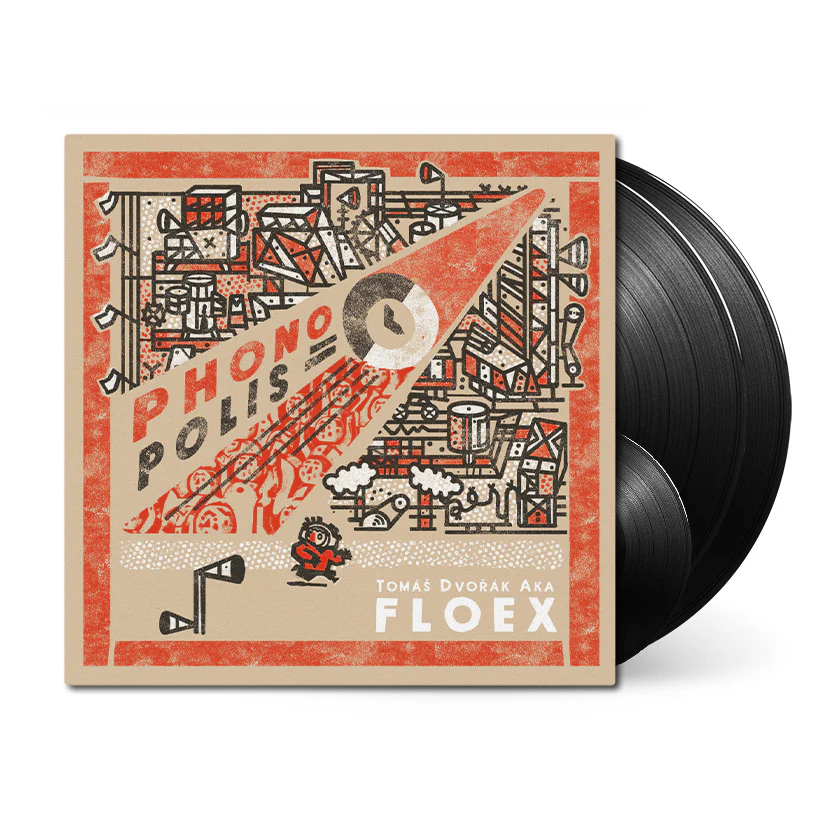
The Phonopolis soundtrack will soon be released on vinyl—just like Machinarium and Papetura. Is this connection to a physical object important to you?
F: It is going to be released very soon, in just a few weeks. Video game soundtracks are so tightly connected to beautiful visual worlds, so it's always a pleasure to turn them into a physical object for people to hold.
I started releasing vinyl a long time ago with Machinarium, back when it wasn't nearly as popular as it is now, simply because I found the format interesting for that specific soundtrack. I found a great collaborator, Dan Dudarec from Minority Records, who established a record label focusing directly on high-quality vinyl releases. Thanks to that partnership, all of my game soundtracks have been pressed to vinyl, though some of the older ones are completely sold out by now.
You are a major figure in the Czech music scene. Could you recommend any artists or bands whose work you particularly enjoy?
F: I'm not entirely sure if I'm a major figure on the local Czech scene, as my audience has always been more international. However, there are a lot of fantastic projects happening across the electronic music scene in the Czech Republic right now.
I highly recommend checking out Aid Kid and his project called Nivva. I also really love the work of my colleague Jan Šikl, with whom I am actually preparing a collaborative album right now, as well as his project with the Zabelov Group.
More emerging names from the modern classical scene are equally interesting - check album Monodie 2 by Beata Hlavenkova, clarinet ensemble “Clarinet Factory”, or composer Jiří Trtik.