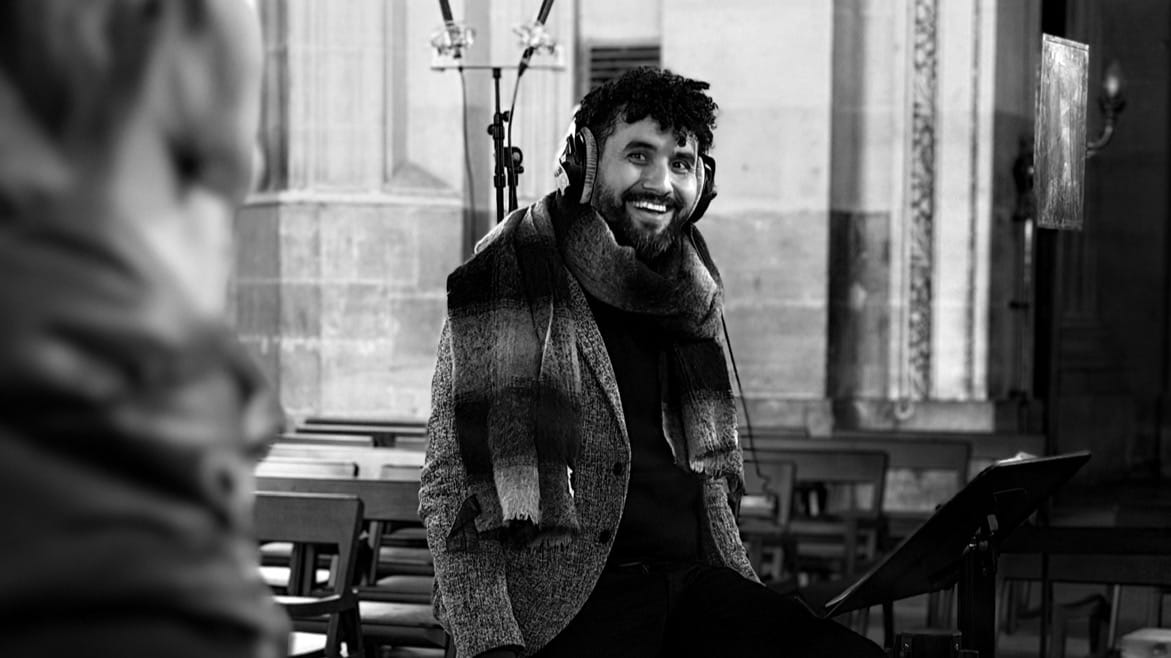
Following the success of Road 96—and particularly its soundtrack, which I’m sure many of you still have on repeat—it’s safe to say that the French studio DigixArt was highly anticipated with Tides of Tomorrow. Its choral soundtrack is just as vibrant as the stunning visuals of this narrative adventure game, where the choices of other players shape your own experience in their own way. I had the chance to sit down with composer Lou Corroyer, whose work was previously heard on another beautifully aesthetic French title, Symphonia.
You graduated about ten years ago but seem to have worked mostly behind the scenes until now. This new game from the creators of Road 96 is quite a spotlight for you. How did you approach such a major project?
Lou Corroyer: I ended up on this project thanks to Aristide Hersant-Prévert, the Lead Audio at DigixArt. We trained together; we did our studies at the same time. He originally called me to compose all the music related to the Mystics in Tides of Tomorrow. They are one of the game's three major communities, alongside the Marauders (represented by Doodseskader) and the Reclaimers (represented by KOKOKO!).
Because I’m close with Aristide, he had me run some tests. He knows my versatility and my interest in exploring different styles. Ultimately, while I was only supposed to do a portion of the soundtrack, I found myself composing much more than expected. It was a great opportunity for me, as I had previously been more "in the shadows," whether in teaching or working on smaller independent productions.
Like Road 96, the Tides soundtrack is a choral effort. We see many artists from very different backgrounds in the credits, which gives the music a wide variety of colors. Can you introduce them to us?
LC: I’m not going to introduce them here because I don’t know them very well. For example, I didn’t interact with KOKOKO! at all. I’ve spoken with Alexis Laugier, but I’ve only known him for a short time. They are fantastic artists, and I’m thrilled we collaborated on this OST, but I think Aristide would be much better suited than I am to talk about them and their work.
You signed the highest number of tracks on the soundtrack. Should we understand that you were the lead composer, or is it just the final distribution that gives that impression? Who steered the musical direction of the game?
LC: Aristide steered the entire musical direction. He wanted an artist or a group to represent each of the three communities, plus a few additional compositions—notably from Alexis Laugier for elements not linked to a specific community. Aristide really sought to build this musical landscape with creators from very different worlds.
On my end, I wasn’t brought on as a lead composer. Initially, I was only supposed to do the Mystics, but then I ended up composing the character themes, which wasn’t planned. I wrote all the thematic work and its variations (quest themes, sad versions, etc.). Furthermore, the game’s main theme—Naé’s theme—was originally a Mystic character theme. As a result, I ended up signing much more than the initial tracks, including the entire final act of the game. Aristide and I work very quickly together, and since composing video game music is my profession, I was able to devote all the necessary time to it.
Is it not distressing for a composer to share the work to this extent with other artists?
LC: It’s not distressing at all because the ground rules were clear from the start: I knew I was coming in for a specific part, the Mystics. I wasn’t promised I would be the sole composer only to be told later that there would be others.
Among the "guests" on the Tides soundtrack, we find the duo Doodseskader and the group KOKOKO!, who produce music that is stylistically very far apart. How did all these people end up collaborating?
LC: There were very few direct collaborations between the artists. KOKOKO! and Doodseskader never interacted with one another, for instance. Aristide was the one who gathered the different elements. Everyone worked somewhat in their own corner, and that’s also why the soundtrack is so eclectic: each artist represents a different geographical and cultural community in the game. KOKOKO! is partly based in Kinshasa, Doodseskader is in Belgium, and I am in the Paris region; we’ve never met.
I did, however, interact with Doodseskader because I composed the themes for certain "Marauder" characters (the community they were working on). Since they didn't necessarily have the time or the habit of doing thematic work, I composed themes that they then revisited. That’s the case for the themes of Obin, Queens of the Stage, and Obin’s daughter.
Yes, I see that you personally signed several tracks with Tim and Siegfried from Doodseskader. How did you work together?
LC: If those tracks are co-signed, it’s because they don’t represent Doodseskader’s usual aesthetic, unlike titles like Plastic Skin. Specifically, I would send them the composed themes as mockups, they would reinterpret them, and Aristide would integrate the whole thing. I occasionally went back over certain tracks, but very lightly.
Tides of Tomorrow is a new kind of narrative game—connected but not strictly multiplayer. I find that the soundtrack conveys the game's very cosmopolitan and humanist character wonderfully without falling into the clichés of "World Music." Was this a desire of DigixArt from the start, or did this direction emerge gradually?
LC: Thank you, that’s nice to hear because the term "World Music" is quite dated and very Western; it’s a term we never used during production. To answer your question, yes, it’s a vision we can attribute to DigixArt and Aristide. He architected this OST by doing a lot of reference work to seek out very different artists.
For my part, I consider the music to be at the service of the game, the narrative, and the gameplay. While KOKOKO! and Doodseskader bring their "signature" and their identity as artists who sell albums, I bring my technical expertise in video games, interactive music, and all the aspects specific to the medium. This cosmopolitan side therefore comes from the mix of DigixArt’s DNA, Aristide’s vision, and the structure we gave the project so it could adapt to the situations presented to the player.
Being a video game music composer implies a certain versatility. You composed tracks in very varied genres for Tides. What was the most fun track to produce?
LC: I did work on styles ranging from ambient to orchestral, all the way to Drum and Bass. I have a versatile profile: I come from a conservatory background, I played the cello throughout my youth, and I studied musicology at the Sorbonne. There, I discovered Turkish music and quarter tones, which completely opened my horizons. It taught me that in music, nothing is ever a given and that you have to seek to understand different musical cultures.
Furthermore, teaching video game composition forced me to find methods for analyzing and reproducing different styles quickly. With Aristide, we are used to moving from a cartoon universe to very dark horror. If I had to pick the funnest track, it would probably be Echoes of the Grid. It’s a heavy Drum and Bass track—a genre I’ve been particularly fond of for about ten years—and I was thrilled to be able to include some in the game.
DigixArt describes its game as "plastic-punk," which I think fits the art direction perfectly. But what does that mean for the musical side?
LC: The Mystics, whom I worked on extensively, aren't the most "plastic" part of the game; the Reclaimers are more in that vein. My approach for the Mystics was much more mental and spiritual. KOKOKO!, for example, makes their own instruments in DIY mode, which I don’t do.
However, Aristide imposed a golden rule for all the artists: no track could contain only virtual instruments. There had to be at least one real instrument, a voice, or something organic.
We occasionally hear voices on your tracks, like on The Prophet or Chased by Fate. Is it yours?
LC: Yes, that is indeed my voice. And when you hear the cello, that’s me as well. I brought my instrument out for the occasion. For me, the voice and the cello were essential to represent the Mystics. They are a religious community, very mental, and the voice felt like an obvious choice. The cello is present nearly everywhere in the game because it is an extremely rich and versatile instrument, capable of very dark tones as well as more moving themes.
Offering a narrative game where choices impact the scenario—what does that mean for the music? I assume the tone of certain tracks might change, or some tracks might trigger sooner than others. Quite a mess to manage, right?
LC: It’s not necessarily more complex than on other games. I didn’t do the integration myself; Aristide handled that. It was a constant game of ping-pong between us: I would suggest structures, he would integrate them, we’d test them in-game, and then we’d adjust. The challenge wasn’t so much the complexity of the integration as the sheer amount of music to produce. The soundtrack is very long compared to the length of a standard playthrough, precisely because this choice-based, branching narrative requires covering many variations.
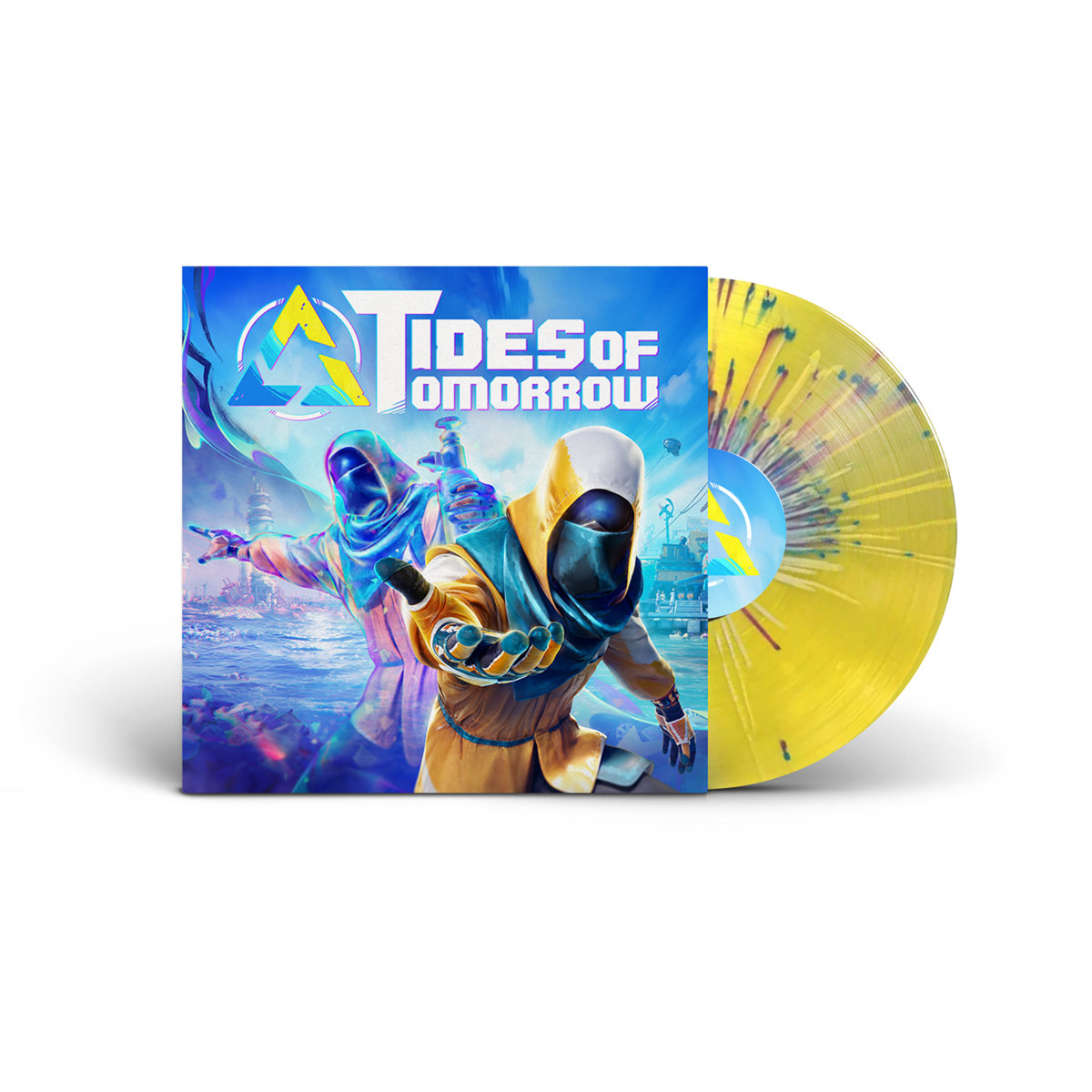
The Tides soundtrack is coming out on vinyl soon via G4F Records. I imagine it must feel like something special to have your music on a real physical object at home?
LC: Definitely! I don’t have the object yet, but it’s been a very long time since I’ve had my music on a physical medium. The last time was for EPs with my band when I was 20. Today, in a purely digital world driven by streaming, returning to a tangible object is a real pleasure.
Tides of Tomorrow is undoubtedly the most ambitious project you’ve worked on so far. What has all of this taught you?
LC: It is indeed my most ambitious project, especially in terms of duration and volume. I spent over a year on it, sometimes full-time. It taught me an enormous amount about work organization and managing such a large quantity of data. I also learned a lot about coherence: even if this soundtrack seems to go in every direction, a sense of unity must emerge from it. I think on a future project, I’ll be able to find that coherence even more quickly.
Road 96 was entitled to additional music. Will we get some "extra" on Tides of Tomorrow as well?
LC: I can’t tell you that. You’ll have to ask DigixArt; I have no information on that subject!