Eli is an artist whose work I’ve secretly adored for a long time, and their OST for the brand-new Wilmot Works It Out is already one of my favorites in the "background music that’s good for the soul" category. So, when an impromptu email from a PR agent offered me the chance to interview Eli Rainsberry for NOWPLAYING, I didn't hesitate for (too) long.
And yes, as I’ve explained before, I’m a bit frustrated that this kind of format isn't widely read or shared by my audience. Nevertheless, it’s always a pleasure to chat with the people who create the music I listen to every single day. So, regardless of the numbers, I’ll keep giving them a voice in these columns for as long as possible.
You’ve probably already heard Eli’s work if you’re a fan of games from Die Gute Fabrik, the studio that sadly closed its doors earlier this year. Always having another trick up their sleeve, the British artist is bouncing back this late 2024 into the Hollow Ponds puddle to score, once again, the whimsical antics of Wilmot.
Hi Eli! A big thank you for agreeing to do this interview. Could you start by introducing yourself for those who don’t know you?
Eli Rainsberry : I make music and sounds for games, animation, and other interactive things, and I’ve been working more on indie games for over the last six years or so. At this point, I might be best known as a frequent collaborator with the studio Hollow Ponds, having worked as audio lead and composer on their Wilmot games, Wilmot’s Warehouse and Wilmot Works It Out, and composing only for Flock.
Other indie games I’ve worked on that some folks might be familiar with include playful experiences like A Monster’s Expedition and Bird Alone, and narrative games like Saltsea Chronicles, No Longer Home, and my next game, Surf Club, which should be out sometime next year.
In recent weeks, you’ve released the soundtrack for Wilmot Works It Out. Can you tell us a bit about the game and your involvement in the production?
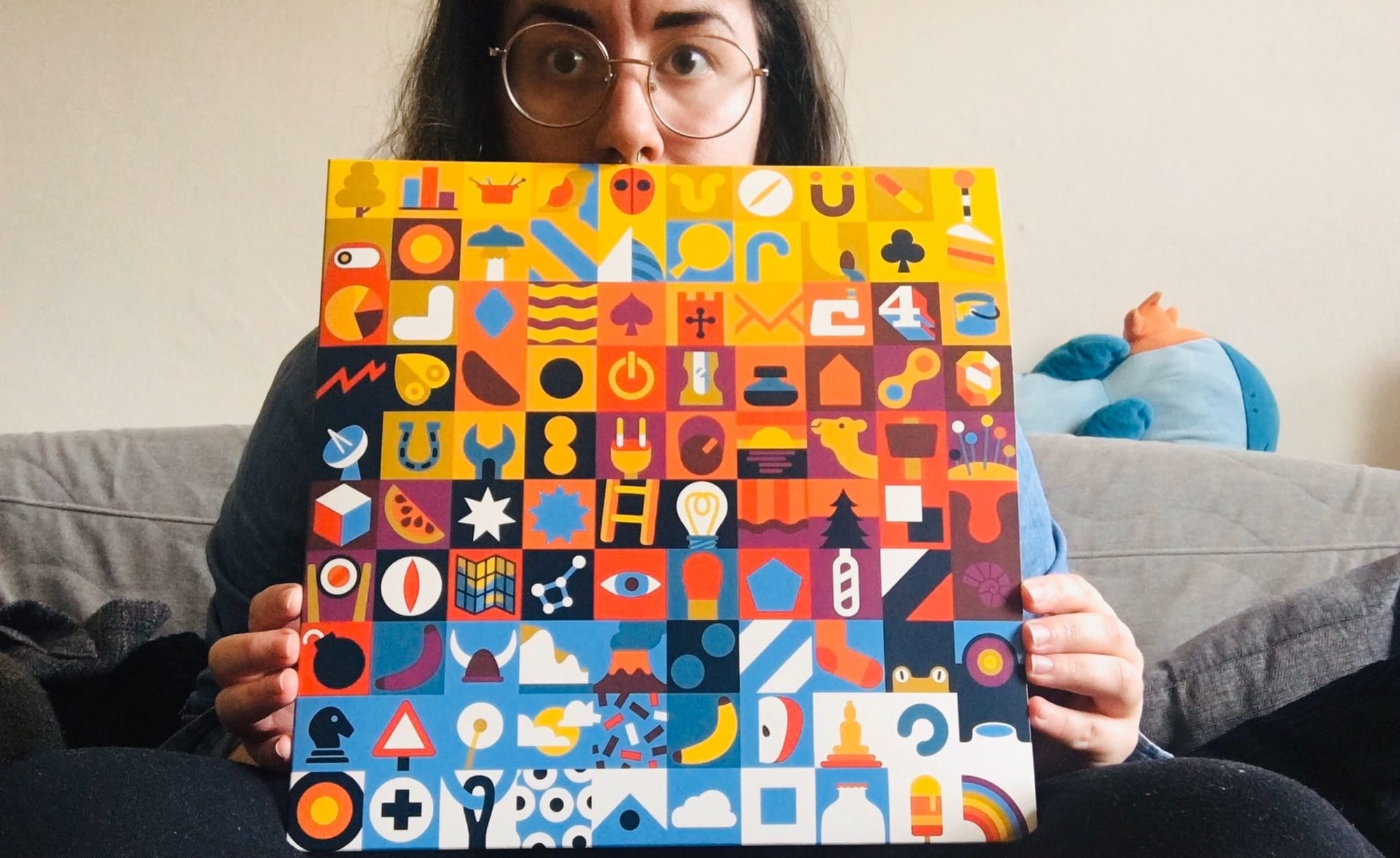
ER : Wilmot Works It Out is a puzzle-building game about completing beautiful images and hanging them in your house. You play as Wilmot, who likes to unwind from sorting out a warehouse by sorting out puzzle pieces! Over the course of the game, you’re completing a series of puzzles to unlock new customisation options for your house.
As audio lead and composer, I collaborated with Ricky Haggett and Richard Hogg on establishing the pre-existing music direction and system for the Wilmot games and how to translate what I’ve done previously for the Warehouse game into the next one. I also collaborated closely with our programmer, Talha Kaya, on creating the tools needed to implement all of the audio in the game. So my roles covered composing the music, designing the sounds, and overall defining the audio ‘palette’ for Wilmot Works It Out, so to speak.
This is the second time you’ve contributed music for a Wilmot game. Do you have a thing for tidying up and organising? Haha.
ER : I try my very best to tidy and organise when on the go! So yeah, definitely a bit of a thing, especially on the organising front.
Wilmot Works It Out is a much more colourful game than its predecessor. It also seems more accessible than Wilmot’s Warehouse, and I feel like this really comes through in your music. There’s something very “satisfying” in the sounds you use, which fit together perfectly with the puzzle pieces as they come together. Could you tell us a bit about your creative process?
ER : I think my creative process mostly covers music, but when it comes to the sound design, I really like taking a more creative approach and having the sounds be informed a bit more by the music. I also like working tonally with the music with some of the sound design—there will be some examples of that to hear out for in the game!
Composing almost always comes first in the process, although my approach will change and be dependent on each project I work on. I try to make the experience as collaborative as possible, and across everything I just absorb as much info and things about what I’m working on as possible. This can be meeting and chatting to developers about any initial direction they want me to take, playing any versions of the game that are currently playable, checking out artwork, reading into any worldbuilding and story aspects of the game, and curating playlists, researching artists I’m inspired by stylistically to use as points of reference.
When actually making the music, I would either use a MIDI controller or guitar to hash out the tracks I’d want to make, and then fine-tune as I’d go. There’d be a lot of trial and error with testing out sounds and textures that I want to try and see if they fit within the ‘palette’ of the work I’m doing. For Wilmot Works It Out, I worked purely with a controller or manually inputting in notes for some extra precision, and built up a library of presets I would make or arrange to make my workflow easier.
When actually composing and arranging the music, I deliberately didn't move away too much from the initial basis of what I built with Wilmot's Warehouse. Some instruments have stayed the same from before but some I've expanded on to generally be more up-to-date compared to five years ago. But there were some melodic ideas and sounds that I know kind of fitted what most folks would define as something more Wilmot-like. In the last game, having technically one basis of an idea to work from and variations to play around with meant that there were quite a lot of recurring melodies, riffs, bass lines, and jingles that could be easily transferable into the newer tracks that I was making.
For example, a thing I’d do is take one or two ideas—or as the music kids like to call them, leitmotifs—that I thought would work well together, then using the template I've been working with for the track, find ways to web it in or build up from there. So I did that over the course of the soundtrack, and also incorporated that into the sound design in some way: for example, the set of sounds for opening the delivery I expanded from one of the more recurring melodies that might be familiar to others who have played the previous game.
I noticed that your compositions for Works It Out are more relaxed, calmer than those for Warehouse, which were at times more energetic and rhythmic. I was re-listening to the soundtrack as I was thinking about these questions, and your music really gives me a “brain massage” effect. It’s relaxing, clever, calm, but there’s still a lot going on. I’m curious to know what inspired you while working on this soundtrack.
ER : As mentioned earlier, I didn’t stray too far from the work I made for Wilmot’s Warehouse, so there was definitely some inspiration left over from what I’ve previously made and built on. It was really nice that I was given a good amount of freedom on what I wanted to compose, even if I wanted to push things a bit by experimenting with time signature changes like I tend to do!
I was limited a little bit by the timescale I had to work on the game, so to avoid ‘crunch’, I had a bunch of very old ideas and arrangements gathering dust that I thought would be sweet to be given a second life in the form of being a Wilmot track. Some were from old non-commercial projects, and some I’d kept aside to develop for some solo work, which was going to be a little more inspired by the kinds of prog-rock I listen to; that might have influenced the direction of the music somewhat! A couple of them are as old as 8 to 10 years old! I feel a lot better hearing them now compared to back then, haha, and working with those pre-existing structures inspired me in terms of how I wanted to improve on what I was composing 10-odd years ago.
I’m going to use this chance to shout out Mort Garson, one of our past electronic music pioneers, as Mother Earth’s Plantasia (1976) was something I tended to listen to in between composing for Wilmot Works It Out! Especially the arpeggiated elements you could hear in some of his work, different tones, textures, and other kinds of synthesis that I would probably get more nerdy over.
How would you define your musical style? I think it’s fair to say you’re drawn to contemplative music—those airy musical spaces that don’t compete with what’s happening on screen but rather accompany it peacefully. That approach doesn’t stop you from mixing things up, though! Your soundtracks for Die Gute Fabrik are very different from those for Hollow Ponds.
ER : I mean, I would describe the ‘accompanying it peacefully’ to describe the things I’ve composed for both Hollow Ponds and Die Gute Fabrik, haha, though yes, stylistically I like to be super varied anyway. I don’t feel like I can put myself into a box that way, and I’m pleased to have tried out a bunch of different kinds of writing across the things I’ve worked on.
The work I’ve done for Die Gute Fabrik is a bit more hybrid and orchestral than other soundtracks I’ve done though; I feel like my practice of that part of my writing is more in its infancy. I would look back on what I’ve done on it and feel like I’ve learned a great deal from working on Saltsea Chronicles. One of the next games I’m working on will go into more of that sort of style, but will be a bit more expressive in terms of incorporating some electronic elements and experimentation with time changes, so I’m hoping I’ll be able to find a middle ground there!
The only thing I feel like has been consistent across most of my work is that it has been influenced a lot by my previous experience writing for prog-rock, jazz fusion, and my time working on either of those sorts of genres as a guitarist. But otherwise, I unfortunately don’t think I have a clear answer to that question yet!
I was listening through your discography while preparing for this interview, and I admit I didn’t expect to find you in such an electronic style as with the Sure Footing soundtrack (2018). Do you ever get the itch to work on another danceable OST?
ER : Sure Footing was one of my earliest soundtracks. I wish I could recall the process of making it properly but I felt like my brain was partly fried from doing a master's degree simultaneously during production of it—a slight fever dream, maybe? It was another project where I learnt a lot!
While I probably don’t make my tracks as fully saturated as I’ve done for that project, it’s probably the most chiptune, digital-fusion inspired soundtrack out of all I’ve done so far, and I would definitely like to compose more of this sort of thing now that I’ve got about six years of extra experience from that release!
You’re a name I’m always excited to see when checking out who’s composing a game soundtrack. But as you know firsthand from what happened to Die Gute Fabrik this year, the game industry is going through a rough patch. So my question is simple: how are you doing? Is it harder to find work now than it used to be?
ER : I’m still really gutted about them ceasing production and I would’ve been really excited to work on their next project, but yes, it’s been deeply frustrating to see what’s been going on. The cautious optimist in me hopes that we’re just in the worst of the cycle before things get better and we get more indie projects being supported.
I do have an advantage where the experience I’ve gained and the degrees I’ve graduated from in the past are broad enough that I could possibly get another job outside of games. And if things really, deeply crumbled for me—for example, if I ran out of money and failed to find a job—I think I would be able to avoid poverty with help from friends/family. But working where I am now, freelancing as a composer and audio designer and working from home, has been the most accessible way that I’ve been able to work. Especially as an autistic person and as someone with ADHD, having to generally work extra hard to communicate and collaborate with others in a way that’s possible, taking extra time and rest where I need to, and more. I think losing that accessibility, even with my privileges, would be a lot, and I’ve definitely felt the stress of that possibility over this year.
I’m fortunately in a decent place now where I have work lined up for next year, and got work including Wilmot Works It Out over the last half of this year. So to answer your question, I’m currently doing okay. During the first half of this year, I did scrape by more, had at least one month with no work, and researched options for work outside of games. It is definitely harder—it’s felt among my fellow audio peers who freelance too—and I am getting a bit more into things like mentorships so that I could develop a basis to possibly teach more if I’m not able to do games work in, say, two years' time. But the main thing is that I’m okay! For now!
Shall we wrap up with some recommendations? Tell me about the music that’s been obsessing you lately.
ER : Sure! There’s always loads that I’m rotating around and I’m going to miss out on a lot of people that deserved to be mentioned, but I’ll list a small handful of music below:
I’m reiterating Mort Garson again, but my favourite albums from him are Mother Earth’s Plantasia and Ataraxia: The Unexplained—the latter if you want to hear some really weird stuff.
Another go-to album I listen to often is Aivi Tran’s tiger & water. They’ve been a long-term inspiration for me as far back as when they worked together with surasshu on the animated show Steven Universe—both of them also created a great album last year, called Meanwhile.
One of my peers in music produces music as Million Sunday; they released DEEPER WATER / FATHERS KEEPER last year, which is so wildly intricate and fun to listen to.
For one of the games I’m working on next, I’ve been listening to and taking inspiration from the Japanese fusion band CASIOPEA, especially their albums from back in the 70s and 80s. I only found out about them last month and it’s been a really nice time trying to figure out and transcribe some of the harmonies and melodies I hear out.
And finally, there seems to be a boost of ambient, electronic music in films as of late and it makes me feel like I could do stuff for film eventually? Maybe? Notable soundtracks include Big Boys (2024, Will Wiesenfeld), Aftersun (2022, Oliver Coates), and All Of Us Strangers (2023, Emilie Levienaise-Farrouch).