As I mentioned in my January mixtape: MIO: Memories in Orbit is my first crush of 2026. And that goes for its soundtrack too, mind you! You’ve already heard a snippet if you listened to my selection of the month.
I remember making faces of surprise, wonder, and pure satisfaction when I first discovered the OST (before the game) during a long train journey. It has to be said, Nicolas Gueguen’s score is perfect for that. With 75 tracks and nearly 4 hours on the clock, we’re looking at a monster of a score—as fascinating and multifaceted as it is full of personality. It was a no-brainer: I had to talk to him. Huge thanks to Kid Katana for making the meeting happen!
Let’s start with you, Nicolas. What’s your musical background, and how did you end up at the helm of the MIO OST?
Nicolas Gueguen : Hi! I was lucky enough to go straight into music studies right after high school at the American School of Modern Music in Paris. You learn writing and arranging alongside intensive instrumental practice; in my case, the piano. It was a very jazz-oriented and theoretical education.
At the same time, I was playing in rock, acid-jazz, funk, and soul bands. I found myself in a small collective around Booster, and we made a record that came out on Blue Note in 2001. Then, through various connections, I joined Beat Assailant, with whom I toured and composed for 10 years.
I got more and more into production and, in my thirties, I did a part-time two-year sound engineering course at SAE Institute. In 2010, I toured with NTM on keyboards: that’s kind of my personal "achievement" as a session musician! After that, I started diversifying my collaborations, doing more audiovisual work for advertising, documentaries, and video games.
I met the studio Douze Dixièmes at an indie game festival in 2017, IndieCade. They were starting their first game, Shady Part of Me, and were looking for someone for sound and music. The collaboration went well, and here we are reunited for their next game, MIO!
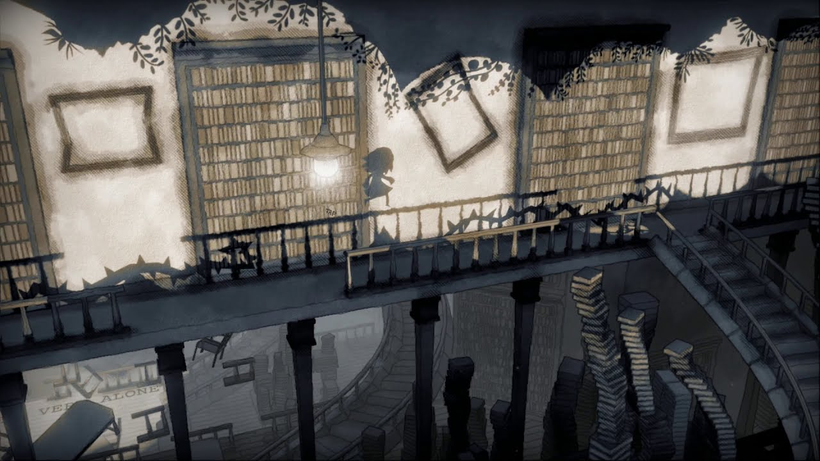
In Shady Part of Me, the vibe was completely different! I’m less familiar with your work; I’ve never seen your name appear so prominently on a game’s OST before. I see you worked on Neurodeck and Shady Part of Me, the previous Douze Dixièmes game?
NG : Yes, because I haven't actually done that much VGM. I composed for Shady Part of Me, for Bravery & Greed, and for Acolyte of the Altar. On Neurodeck, I did the SFX. I also did sound design for Roguebook and spent three years at Dontnod as Audio Lead.
MIO has been a very long-term project for the studio. At what point did you join the team? Usually, music is one of the things that comes quite late in production.
NG : I joined the production very early, back in 2021. We were just coming off Shady Part of Me and we wanted to go deeper, to start thinking and iterating early on. This really allowed the music to mature and grow with the project; it’s a real privilege to start that early.
Can you tell me about the brief you received for the game’s soundtrack? I’m curious how such a unique universe is pitched to a musician.
NG : Douze Dixièmes presented the game, the concept art, and the lore. Based on that, I pitched a concept: an OST with two central sounds—synths and choir—symbolizing the game's main protagonists.
From there, I made the first demos. I called my very good friend Dynah to work on the vocals, and quite early on, we did a day of recording with the full choir to definitively lock in the direction.
It’s rare for a game of this scope (meaning "indie-style") to treat itself to such a rich soundtrack. 75 tracks, nearly 4 hours... it’s insane! Was that the studio’s wish? Or just inextinguishable creativity on your part?
NG : A bit of both? No, it wasn't a request from the studio, who originally ordered much less than that. But with the controller in hand, it’s impossible to hold back when you feel an area needs music or a theme.
Navigating the biomes is so inspiring! So we agreed to produce more music. Electronic music is "easier" to produce because it only involves me, which helps with being prolific. The decision to have custom music for every boss added to the track count too!
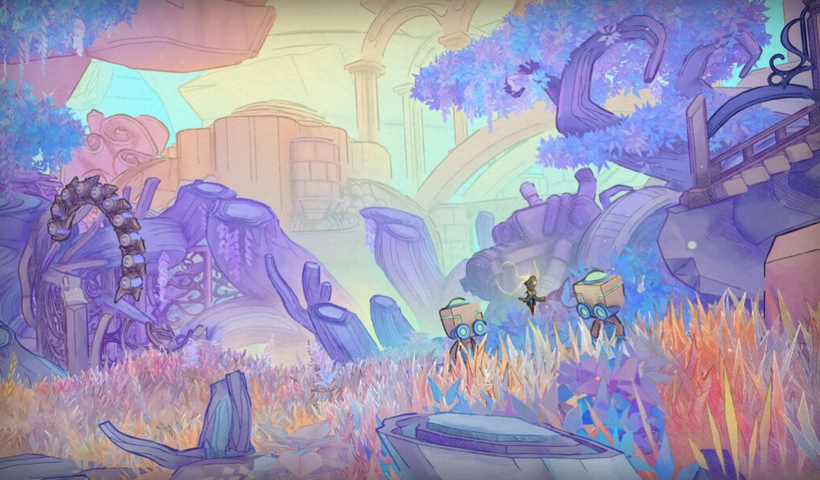
It’s an understatement to say that MIO’s art direction is inspiring. I’d file the OST under the giant umbrella of "electronic music," but that’s a bit reductive. There are several very ambient tracks, but also almost jazzy ones with that Rhodes keyboard on a few tracks, like the superb Dwellings. How did you find the "sound" of MIO?
NG : Limiting your sonic palette helps a lot in finding an identity. The watchword was "synths and voices," and the mood had to be melancholy, dark, and empty. During production, you have these little revelations: you use a sound and feel it fits the identity perfectly, so I go back into the other tracks to use it there too.
The choirs really define the identity; as soon as you record live musicians, it imprints a specific color. I also used a reverb pedal that worked very well on all the choirs; it contributed a lot to the overall "glue."
As for the Rhodes, it strays a bit from the musical direction, but I thought it worked well for the ice biome. And besides, I’m an absolute Rhodes fan, so I always sneak it in somewhere. I also tried to "dirty up" the sound by running it through various saturation boxes—some gritty stuff. I can't say the sound of the OST is particularly lo-fi, but there’s a slight patina that contributes to the overall coherence.
Do you listen to a lot of video game music for inspiration? Discovering the MIO OST, I found many sounds that reminded me of the work of Amos Roddy (Citizen Sleeper) and Disasterpeace (Hyper Light Drifter). Who were your models for this project?
NG : Hyper Light Drifter, yes! I’m a huge fan of Disasterpeace and that was one of the starting references. There was also Ben Prunty, as well as Peter Talisman and his exceptional OST. Outside of VGM, there was Lorn and Deru for their electronic music with lots of grain and life.
I think my favorite track is "Surrounded," which plays when you fall into an ambush. It’s always a very stressful moment in-game. Yet, I find this track very playful, as if it’s trying to teach us a dance, to keep our cool. I’d love to know the story behind this one!
NG : It’s one of the very first tracks for the game, originally composed for the first "vertical slice" presented to the publisher. A guideline emerged pretty quickly for the music: exploration = no percussive elements; combat = dominant percussive elements. The arena being somewhere in between (half-exploration / half-beat), this track was perfect!
It went through a lot of redesigns before ending up as arena music and, as a result, it’s a bit of a patchwork that’s a little too long for the average length of a fight. Most players will never hear the final part! Since you mentioned this track, I dove into the hard drives and pulled out its evolution.
- Flamby_Level2_20210803: First version as exploration music in 2021! The track has distinct parts that shifted based on the narrative of the Garden biome. There are VST choirs on it. (Note: "Flamby" was the game's codename for years).
- Garden_ARENA_20231215: Second version in 2023. The track finds its place for the arena and kept its evolutions for the different enemy waves.
- Garden_ARENA_20231229: Third version a few days later, stripped back. The theme was too heavy and "chatty" for combat. There was way too much reverb!
- Garden_ARENA_20240916: This grooves much more! I re-recorded the bass with the Andromeda A6 for a big, mellow sound and nicer articulation. The quiet part is now more sustained and funkier, and you can hear the Prophet VS strings I put everywhere. No "live" choirs for this one: the "fake choirs" work great, so we're keeping them! And we dropped the wave system for a linear track played in every arena.
- Garden_ARENA_20250319: The version heard in-game. The track is mixed, low frequencies are contained so they don't take up too much space, and we aim to keep maximum dynamics for the gameplay.
- 9_Surrounded_20250406_mix: Mixed version for the OST. The bass is a bit more relaxed, the mix has more saturation, and the dynamics are tighter. We’re looking for more "loudness."
Your turn now: which track are you proudest of on the BO, and why?
NG : Haha, tough question! It’s like asking me which of my children I prefer—it’s impossible. Special shout-out to Marc who asked me the same thing and got the same answer. Even if tracks like Librarians or Toumtoum make me very happy. They are sort of hybrid experiments between electronic music and choir that are just a series of happy accidents for which I don't have the "recipe."
There are a lot of choirs in the MIO OST. I was quite surprised to discover that you called on live singers. I even saw a fun little wink in it: bringing humanity back into a game that depicts synthetic beings. Was it inconceivable for you to use VSTs?
NG : Not at all, I use them a lot. At the start of production, I bought pretty much every choir VST available and started playing around with them. It was cool for demoing, but very quickly limited in terms of expressiveness; we needed breath and humanity.
It turns out that Dynah, with whom I often collaborate, is a member of the a cappella group Ommm. It was a stroke of luck to have a group of artists used to their own sound and to working together. So we recorded Ommm (Melody Linhart, Manon Lattoni, Marion Cassel, and Mathis Capiaux), with Veronica Mounié and John Linhart as reinforcements. The first session helped define how I was going to use voices in the score. There were two years between the two recording sessions.
I read a review of the game that compared your work to a "Daft Punk-esque" sound. Do you take the compliment?
NG : Haha, of course I take the compliment! For me, it’s mostly linked to the sound of the vocoder. People hear a vocoder and they say: "Daft Punk!".
I think MIO is already standing out as a superb discovery for me in 2026. Are there other video game projects you're working on that you can already tell us about?
NG : Unfortunately no, nothing I can reveal at the moment. :)
Let’s wrap up with some recommendations. What’s the album on heavy rotation at your place right now?
NG : The latest album by Dijon, Baby—incredible, just like the previous one. Sault, who continues their impeccable series of albums with Chapter 1. And the beat album by Deru, Rhythm Tapes (go check out "Gemini," it’s a treat).